Why Barbershop Software Must Work Differently From Salon Software
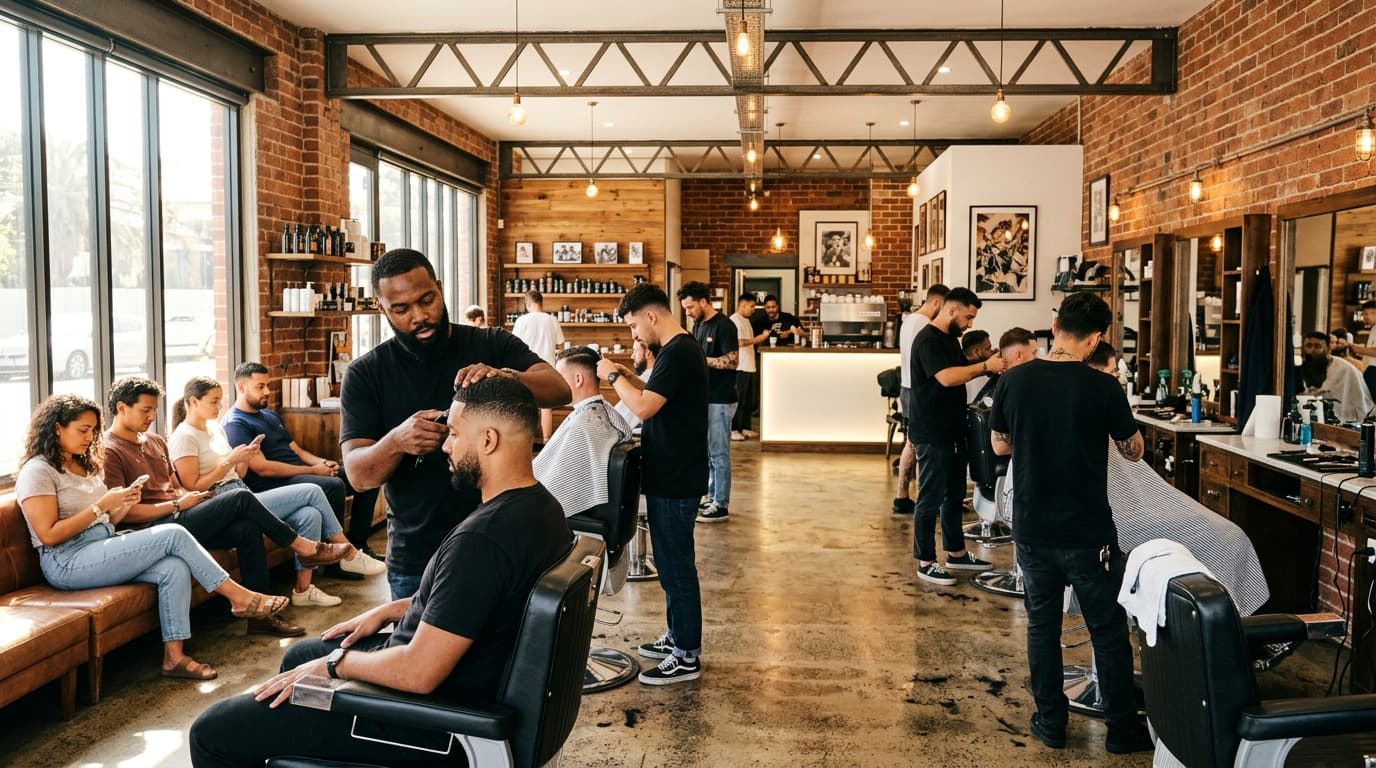
Barbershops are not slow-paced. A busy Saturday might see a single barber complete 20 cuts before lunch. That rhythm, that volume, that reliance on walk-ins rather than pre-booked appointments, makes the average barbershop a fundamentally different business from a colour salon. Yet most scheduling software treats them the same. That mismatch costs real money every single day.
Walk-Ins Are the Business Model, Not the Exception
In most salons, walk-ins are a bonus. In most barbershops, they are the core revenue stream. Clients do not book six weeks ahead for a fade. They finish work, walk past the shop, and check whether the wait is reasonable. If the queue looks manageable, they come in. If it looks chaotic or unknown, they keep walking.
Software built for appointment-only flows handles this badly. It shows a calendar full of pre-booked slots and treats the empty ones as available for online booking. It does not account for the three people already sitting in chairs, the two waiting on the bench, or the realistic wait time for the next walk-in. The result is a booking page that bears no relationship to what is actually happening on the floor.
Queue management and live wait-time estimation matter far more to a barbershop than a polished online booking funnel. Clients want to know: how long is the wait right now? Software that cannot answer that question in real time is solving the wrong problem.
The 20-Minute Appointment Problem
Most salon software defaults to 30-minute scheduling blocks. For a colourist booking a full head of highlights, that is fine. For a barber doing a skin fade and a line-up in 18 minutes, it creates a structural problem.
When every appointment is forced into a 30-minute block, the calendar fills up with phantom gaps. A barber completing six cuts per hour is shown as available for only four. That difference, two cuts per hour across a busy six-hour Saturday, is 12 missed appointments. At $30 a cut, that is $360 in a single day that the software has quietly written off.
Realistic estimates put the daily loss at two to three cuts per barber when rigid block scheduling is applied to a rapid-cycle shop. Across a four-chair barbershop, that adds up to a significant revenue gap that never appears on any report because it is invisible. The appointments simply do not exist in the system.
Software that supports flexible appointment durations, and that allows barbers to set their own realistic service times, closes that gap. The calendar reflects reality. The chair stays productive.
The Chair Is the Scheduling Unit, Not the Stylist
In a salon, the stylist is the primary scheduling unit. Clients book with their colourist or their extension specialist. The chair is just where they happen to sit.
In a barbershop, the dynamic is often reversed. Clients may have a preferred barber, but walk-in traffic fills whichever chair is free. The business owner thinks in terms of chair occupancy, not individual barber diaries. A chair sitting empty for 40 minutes is a cost, regardless of who is rostered to it.
Software that only shows a stylist-first calendar forces barbershop owners to mentally translate between what the screen shows and what the floor looks like. The calendar should show the chair as the primary unit, with the assigned barber visible within it. That single change makes scheduling decisions faster and more accurate during a busy period when there is no time to think.
Commission Structures That Actually Fit
Salon commission typically runs as a percentage of service revenue, often somewhere between 40% and 55%. That model is common in colour salons and blowdry bars. It is less common in barbershops.
Barbershop compensation usually works one of two ways: a flat weekly chair rent, or a straight 50/60 split of takings. Neither of these maps neatly onto a percentage-of-service model. Chair rent is a fixed cost regardless of revenue. A 50/50 split is straightforward but needs to be tracked per barber, per day, without requiring the owner to export data into a spreadsheet every Friday.
Software that only supports percentage-of-service commission forces barbershop owners into workarounds. They end up doing the real payroll calculation manually, which defeats the purpose of having management software at all. The platform needs to support flat weekly rent and split-of-takings models natively, with clear per-barber reporting that makes end-of-week payroll a five-minute job rather than a 45-minute one.
What Good Barbershop Software Actually Does
It shows live queue status so walk-in clients can make an informed decision before they even step through the door. It uses realistic appointment durations so the calendar reflects actual capacity. It organises the schedule around chairs first, with barbers assigned to those chairs, not the other way around. It tracks chair rent and split-of-takings without requiring a workaround.
It also handles the payment mix that barbershops actually see. Cash is still common. Card payments need to be fast. Tipping needs to be easy. The checkout flow cannot slow down a barber who has the next client already in the chair.
OpenChair is built to support all of these scenarios. The scheduling engine supports flexible service durations, chair-first calendar views, and commission structures that include flat rent and percentage splits. The AI Concierge handles incoming calls and booking requests without the barber needing to stop mid-cut. Intelligence reporting shows per-barber performance, chair utilisation, and daily revenue without requiring manual data entry.
The Cost of Using the Wrong Tool
Using salon software in a barbershop is not just an inconvenience. It actively costs money. Phantom gaps reduce daily capacity. Inaccurate wait times push walk-in clients to the shop next door. Manual payroll calculations eat into the owner's time every single week.
The businesses that grow fastest are the ones where the owner is not constantly fighting their own systems. When the software understands the business model, the owner can focus on the floor, the team, and the clients. That is where the real work happens.
Smarter venue management starts with software that is built for how your business actually operates. For barbershops, that means chairs, queues, fast cycles, and flexible pay structures. Not a salon calendar with the logo changed.