AI in Your Salon: What It Actually Does, What It Doesn't, and How to Tell the Difference

Most AI marketing is written for people who already believe. This post is for operators who don't. If you've sat through a software demo where someone said "AI-powered" three times in one sentence and still couldn't explain what the thing actually does, this is for you.
The honest answer is that AI does some things very well in a salon context, some things adequately, and some things not at all. Knowing the difference is worth more than any feature list.

What AI Is Actually Good At in a Salon
Start with the tasks that are repetitive, pattern-based, and time-consuming. These are where AI earns its keep.
Drafting SMS campaigns from almost nothing. You type "winter colour promotion, 20% off toning" and a well-trained AI returns a ready-to-send message in your brand's tone, with a call to action, inside ten seconds. You still approve it. But the blank-page problem disappears. For operators who send one campaign a quarter because writing copy feels hard, this alone changes behaviour.
Spotting clients who are overdue. AI can scan your booking history and flag every client who hasn't been in for longer than their usual interval. Not just "inactive for 90 days" as a blunt filter, but "this client books every six weeks and it's been eleven." That's a meaningful distinction. A targeted win-back message to that person converts at a far higher rate than a bulk discount blast.
Identifying pricing gaps in your service menu. If your balayage takes 3.5 hours and you're charging the same as a full-colour that takes 90 minutes, that's a margin problem hiding in plain sight. AI can surface those gaps by comparing service duration, booking frequency, and revenue contribution. It won't tell you what to charge. It will tell you where to look.
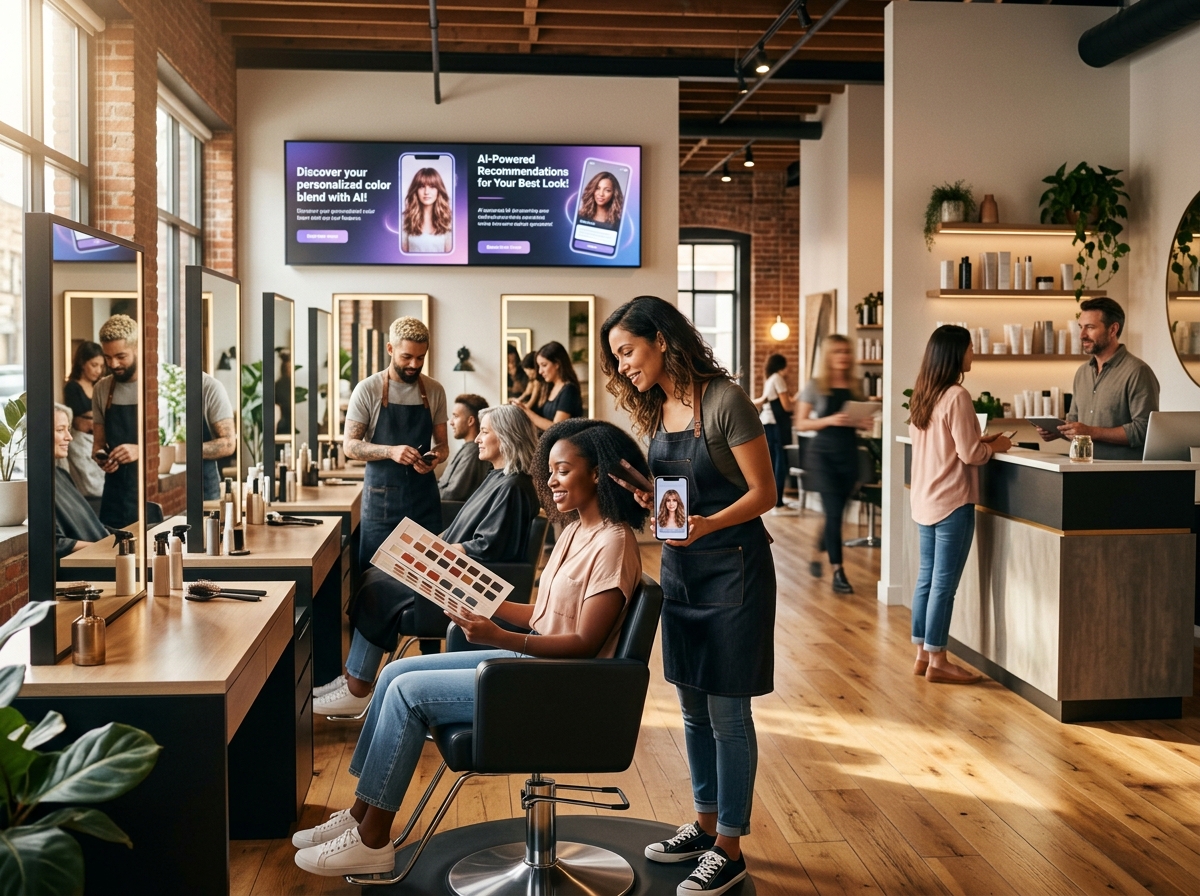
Matching client photos to services during booking. A client uploads a reference image. AI reads the colour, the cut, the texture, and suggests the most relevant service from your menu. This reduces booking errors, cuts the back-and-forth at the front desk, and means the stylist walks into the appointment with better information. It doesn't replace the consultation. It makes the consultation more useful.

What AI Does Poorly
This is the part most software companies skip. They shouldn't, because operators who discover the limits on their own tend to write off the whole category.
Taste and creative judgement. AI cannot tell you whether a haircut will suit someone's face shape, whether a colour will work with their skin tone, or whether a client's vision is achievable in a single session. These require a trained eye and years of experience. No language model has either.
Relationship nuance. When a long-term client says she wants to go platinum blonde, your front desk knows whether that means "I've been thinking about this for months" or "I saw a TikTok this morning." AI reads the words. It cannot read the history, the tone, or the relationship. The front-desk conversation is irreplaceable.
Anything that requires real-time human context. A client calls to say she's running late, she's stressed, and she's not sure she wants the treatment she booked. How you handle that call determines whether she stays a client. AI can answer the phone and take a booking. It cannot manage that moment.
Predicting taste shifts. AI is trained on historical data. It is good at identifying what has happened. It is poor at anticipating what a client wants next when that want is driven by something new in their life, a change in season, or a trend that just broke.

How to Tell the Difference in Practice
Here's a useful test. Ask yourself: does this task have a correct answer, or does it require judgement?
If there's a correct answer, AI can probably help. Identifying overdue clients has a correct answer. Drafting a grammatically sound, on-brand SMS has a correct answer. Flagging a service that's priced below its cost-per-hour has a correct answer.
If it requires judgement, a relationship, or taste, AI is a tool at best and a liability at worst. Don't use it to make those calls.
The operators who get the most from AI are the ones who treat it as a capable junior assistant. It does the prep work. It surfaces the information. It drafts the first version. The operator makes the decision.

Why Pay-Per-Use Matters More Than You Think
Most platforms bundle AI into a monthly fee whether you use it or not. That model creates a quiet pressure to use AI everywhere, because you've already paid for it. That's how operators end up with AI-generated responses to client messages that sound robotic, or automated follow-ups that go out at the wrong moment.
OpenChair uses Sparks, a pay-as-you-go credit system where one Spark costs one cent. You spend Sparks when you use an AI feature. You don't spend them when you don't. Pro venues get 500 Sparks per seat pooled each month, with a cap of 5,000, which covers meaningful usage without waste.
This matters because it changes the incentive. You're not trying to justify a sunk cost. You're choosing, action by action, where AI adds enough value to be worth a few cents. That's a much healthier relationship with the technology.
It also means you can measure the return. If an AI-drafted Reconnect campaign costs 40 Sparks to generate and send, and it recovers two appointments worth $280, the maths is obvious. If it costs 40 Sparks and recovers nothing, you know that too.
The 30-Day Test Worth Running
Scepticism is healthy. The best way to move past it is a bounded experiment with a clear outcome.
Pick three AI features. Run them for 30 days. Measure one outcome each.
For automated client win-back, measure recovered revenue from clients who hadn't booked in over their usual interval. For AI-drafted campaigns, measure open rate and booking conversion against your last manually written campaign. For smart booking suggestions, measure whether appointment errors or front-desk corrections dropped.
At the end of 30 days, you have numbers. Not a vendor's case study. Not a demo. Your numbers, from your clients, in your venue.
If the numbers are good, expand. If they're not, you've spent a small amount of Sparks and learned something specific. That's a better outcome than either blind adoption or permanent scepticism.
The Right Frame for AI in a Salon
AI is not going to run your salon. It is not going to replace your best stylist, your front-desk manager, or your instinct about what a client actually needs. Any platform that implies otherwise is selling something that doesn't exist.
What AI can do is handle the parts of your operation that are repetitive, data-heavy, and time-consuming, so the people in your venue can spend more time on the parts that actually require them. That's a meaningful gain. It's just a smaller, more specific gain than the marketing usually suggests.
The operators who benefit most are the ones who go in with clear eyes: knowing what the technology can do, knowing where it stops, and building their workflow accordingly. That's not a limitation. That's how any good tool works.
Smarter venue management doesn't come from adopting every AI feature available. It comes from knowing which ones solve a real problem in your specific business, testing them honestly, and building on what works.