Gift Cards Are Not a Christmas Gimmick: How to Turn Them Into a Year-Round Revenue Stream
Gift cards are pre-paid revenue and a zero-cost acquisition channel. Here's how to sell them year-round and turn every redemption into a bigger ticket.
On this page
Gift cards are pre-paid revenue that lands in your account before a single appointment is booked. Most salons treat them as a Christmas product, pull them out in late November, and pack them away in January. That's leaving money on the table for eleven months of the year.
The mechanics are simple: someone pays you now, a client visits later, and that client almost always spends more than the card value. Done properly, gift cards are one of the few revenue tools that simultaneously improve cash flow, bring in new clients, and increase average ticket size.
Gift Cards Are a Built-In Acquisition Channel#
Here's the part most salon owners overlook. When someone buys a gift card, they are not the one who will sit in your chair. The redeemer is often a first-time visitor who arrives with zero acquisition cost to you.
Think about what you'd normally pay to bring in a new client. Google ads, Instagram promotions, referral incentives. A gift card buyer does that work for you, and pays you upfront to do it.
That new client arrives already warm. Someone they trust recommended your salon enough to spend $100 on it. They walk in with social proof baked in. Your job is simply to give them a reason to rebook.
The Maths Behind Breakage and Add-On Spend#
Breakage is the industry term for gift card value that is never redeemed. Across retail, the average sits between 10 and 15 percent. For every $1,000 in gift cards you sell, $100 to $150 may never be claimed.
That is pure margin. You have already been paid. No appointment, no product cost, no staff time.
But here's the more interesting number: even when cards are fully redeemed, the average visit includes $20 to $40 in add-on services beyond the card value. A client with a $100 gift card doesn't want to leave $10 on the table, so they add a treatment, a product, or a brow tidy.
Combine breakage income with add-on spend, and the effective yield on a $100 gift card sale is often closer to $115 to $130. That's before you factor in the rebooking rate of those new clients.
Why Year-Round Promotion Beats the Christmas Rush#
Christmas, Mother's Day, and Valentine's Day are obvious windows. You should absolutely push hard during those periods. But if that's your only strategy, you're capturing maybe 30 percent of the gift card opportunity.
Birthdays happen every day. Work anniversaries, engagements, baby showers, thank-you gifts. These are all moments where someone needs a thoughtful present quickly. If your gift card is easy to find and easy to buy, you capture those impulse purchases. If it's buried on your website or only available in-store, you don't.
The fix is straightforward. Put your gift card link in three places permanently: your booking page, your Instagram bio, and your Google Business Profile. Add a prompt at checkout for staff to mention it: "We do digital gift cards if you ever need a last-minute present." That one sentence, said consistently, adds up.
Your booking page is often the first impression a new client gets. Make sure it reflects your brand and makes the gift card option obvious, not an afterthought buried in a footer.
Digital Cards Remove Every Friction Point#
Physical gift cards have real costs. Printing, storage, handling, the risk of losing them, the awkward conversation when someone wants to redeem a card that's been sitting in a drawer for two years.
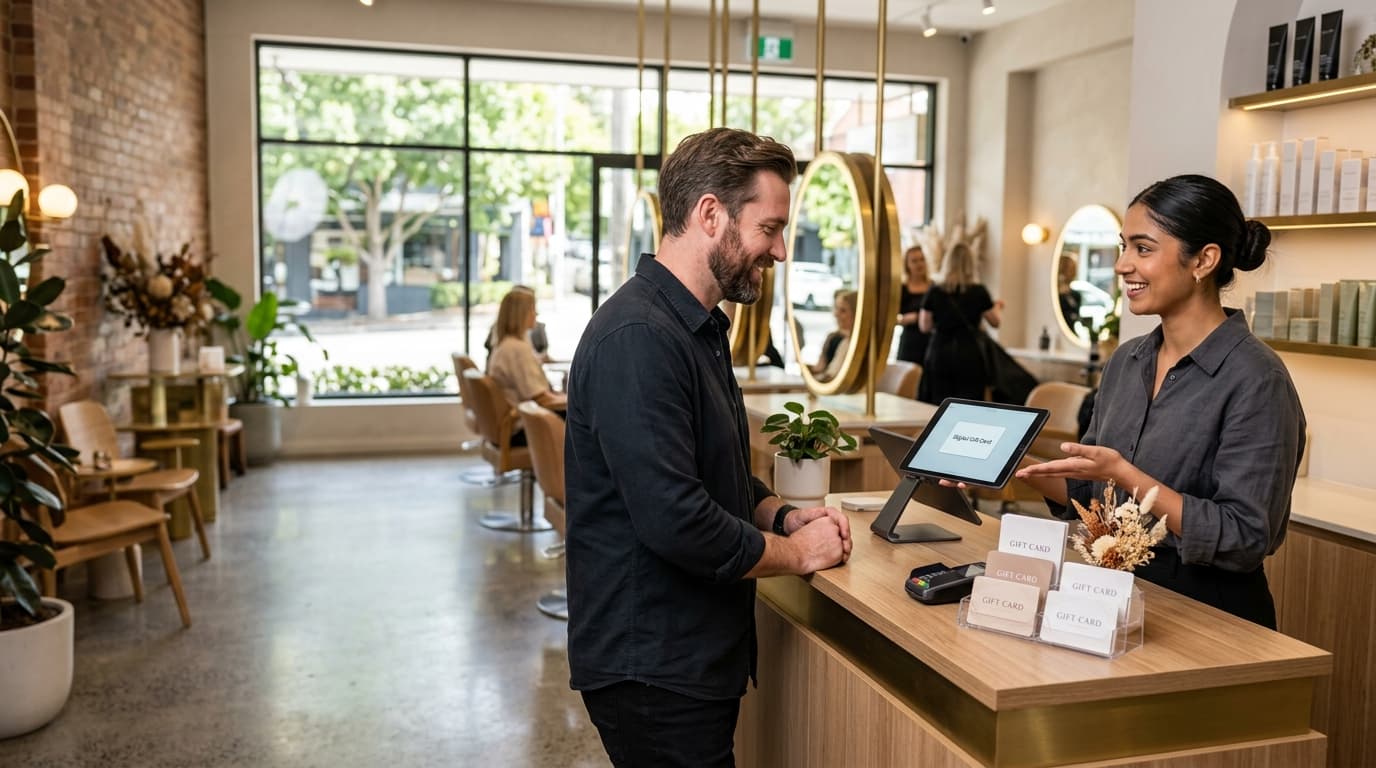
Digital gift cards solve all of that. The buyer purchases online in under two minutes. The recipient gets a code by email or SMS. They book online using that code. You never touch a physical card.
The whole transaction is self-contained. It works at 11pm on a Sunday when someone realises their mum's birthday is tomorrow. That's the moment you want to be available for.
For salons running on a platform like OpenChair, digital gift cards sit inside the same system as your bookings and client records. When the recipient redeems, their visit is tracked, their profile is created, and your follow-up automations kick in automatically.
Pricing Strategy: Round Denominations Over Service-Specific Cards#
Service-specific gift cards sound thoughtful in theory. A "Full Balayage Gift Card" feels personalised. In practice, they create problems.
Prices change. Services get renamed. A client who receives a "balayage card" might want highlights instead. And if your balayage costs $180 but the card is $100, the conversation at checkout gets awkward fast.
Round denominations fix this cleanly. Offer $50, $100, and $150 options. The recipient has full flexibility to apply the value to whatever service they want. There's no mismatch, no explanation required, and no uncomfortable moment at the desk.
The $50 card is your entry point for impulse buyers and lower-budget gifters. The $100 card is your workhorse. The $150 card is for clients who want to give something genuinely generous. Some salons add a $200 option for high-ticket services like colour corrections or bridal packages.
Keep it simple. Three or four denominations is enough. Too many options create decision paralysis and reduce conversion.
How to Promote Without Being Pushy#
Gift card promotion doesn't require a hard sell. It requires visibility and timing.
At the point of checkout, a simple mention works. "We have digital gift cards if you ever need one." No pressure, no script. Just planting the idea.
On social media, post about gift cards four to six times a year outside of the major holidays. A post in late October (pre-Christmas planning), one in late March (pre-Mother's Day), one in June (mid-year birthdays), and one in August (Father's Day in Australia and New Zealand). Each post should show the card, explain how to buy it, and include a direct link.
Email campaigns are highly effective here. A short message to your client list before each gifting season, with a clear call to action, consistently outperforms social posts for conversion. Your existing clients are your best gift card salespeople. They already trust you. They just need the prompt.
If you're using OpenChair's Communications tools, you can schedule these campaigns in advance and segment by client value. High-spend clients are more likely to buy premium denominations. Sending them a targeted message around key dates takes minutes to set up and runs automatically.
Turning Redeemers Into Regulars#
The gift card visit is your audition. The redeemer is a potential long-term client who arrived through someone else's recommendation. Your job is to convert them.
This starts before they sit down. Make sure their intake form captures their preferences. Have their stylist review any notes before the appointment. Treat it like any first visit, because that's exactly what it is.
After the visit, your follow-up sequence matters. A thank-you message the next day. A rebook prompt at the two-week mark. If they don't return within 60 days, they're at risk of becoming a one-visit wonder.
The win-back playbook for clients who haven't visited in 60 days applies directly here. Gift card redeemers who don't rebook within eight weeks need a nudge, not a write-off.
OpenChair's Reconnect feature handles this automatically. It identifies clients who haven't returned and sends a multi-wave sequence on your behalf. You set it up once. It runs in the background and brings people back without you having to remember who needs a follow-up.
A Checklist to Get Started#
Here's what to put in place this week:
Set up digital gift cards in your booking platform. Round denominations: $50, $100, $150. No service-specific cards.
Add the gift card link to your booking page, Instagram bio, and Google Business Profile. Make it findable without effort.
Brief your team on the checkout mention. One sentence, no pressure. "We do digital gift cards if you ever need a last-minute present."
Schedule four to six social posts across the year. Pre-Christmas, pre-Mother's Day, mid-year, Father's Day. Use a direct purchase link in every post.
Set up a post-redemption follow-up for first-time visitors. A thank-you message the day after, a rebook prompt at two weeks, and a win-back sequence if they don't return within 60 days.
Track your gift card revenue separately so you can see breakage, redemption rate, and add-on spend. These numbers will tell you which denominations sell best and which seasons drive the most volume.
Gift cards are not a side product. They are a cash-flow tool, a client acquisition channel, and a retention mechanism rolled into one. The salons that treat them that way sell them consistently, not just in December.
Building this into your regular operations is the same principle behind how a Melbourne colourist scaled from solo to three chairs: small systems, run consistently, compound into real results. Gift cards are one of the simplest systems you can add today.