The Referral Machine: How to Turn Your Best Clients Into Your Best Marketing Channel
Word of mouth drives most salon bookings, but most owners treat it as luck. Here's how to build a referral system that works consistently.
On this page
Word of mouth is already your best acquisition channel. Ask any salon owner where most new clients come from and the answer is almost always the same: "Someone told a friend." The problem is that most owners treat this as something that just happens, rather than something they can design.
It can be designed. And when it is, it compounds. A referral programme that consistently brings in two or three new clients a week adds up to 100 or more new clients a year, without a single paid ad.
Here is how to build one that actually works.
Why Most Salons Leave Referrals to Chance#
The default approach looks like this: do great work, hope clients tell their friends, maybe mention it in a newsletter. That is not a referral programme. That is wishful thinking dressed up as a strategy.
The reason it stays passive is usually one of two things. Either the owner assumes that asking feels pushy, or they have tried a generic loyalty programme that did not move the needle and concluded referrals are just hard to systematise.
Neither assumption holds up. Clients who love your work genuinely want to tell people about you. They just need a nudge, the right moment, and a frictionless way to do it.
The Three Conditions for a Referral to Happen#
Referral psychology is not complicated. A client refers when three conditions are met.
First, they had a great experience. This is the obvious one. No programme rescues mediocre work. But "great" does not always mean the most technically impressive colour result. It means the client felt seen, the appointment ran on time, and they left feeling better than when they arrived.
Second, they were asked at the right moment. Timing is everything. A generic email two weeks after their visit asking them to "refer a friend" lands when the emotional high has faded. The right moment is at checkout, when the client is in front of the mirror, happy with what they see, and still in the room with you.
Third, referring felt easy. This is where most salons fail. Even a motivated client will not refer if the mechanism is clunky. "Just tell your friends about us" is not a mechanism. A physical card they can hand over, or a short booking link they can text in thirty seconds, is.
Most salons clear the first hurdle. They stumble on the second and fall over on the third.
The Optimal Referral Ask#
The ask should happen at checkout, not in a follow-up email. This is the single biggest timing mistake salons make.
At checkout, the client is happy. The result is fresh. They are already thinking about when they will be back. That is the moment to say something like: "We would love it if you told a friend about us. If they book with us, you both get $15 off your next visit."
That is it. No long explanation. No form to fill in. Just a clear, mutual benefit delivered in ten seconds.
If you have a physical card, hand it to them then. If your booking system generates a personal referral link, show them how to share it on their phone before they leave. The goal is to get the mechanism into their hands while they are still standing in your salon.
Follow-up emails have their place, but they work best as a reminder for clients who did not act in the moment, not as the primary ask.
Referral Mechanics That Actually Work#
Keep the structure simple. The programmes that perform best for salons are not complex points systems. They are straightforward bilateral rewards.
A working structure looks like this:
- The referrer gets $15 off their next visit when the friend books and completes their first appointment.
- The new client gets $15 off their first visit as an incentive to book.
- The reward triggers only when the appointment is completed, not just booked. This filters out no-shows and protects your margins.
The $15 figure is a starting point. For a salon where average ticket is $80 or more, $15 to $20 per side is meaningful without being expensive. For a barbershop with a $35 cut, $10 per side might be the right number. The point is that it should feel like a genuine thank-you, not a token gesture.
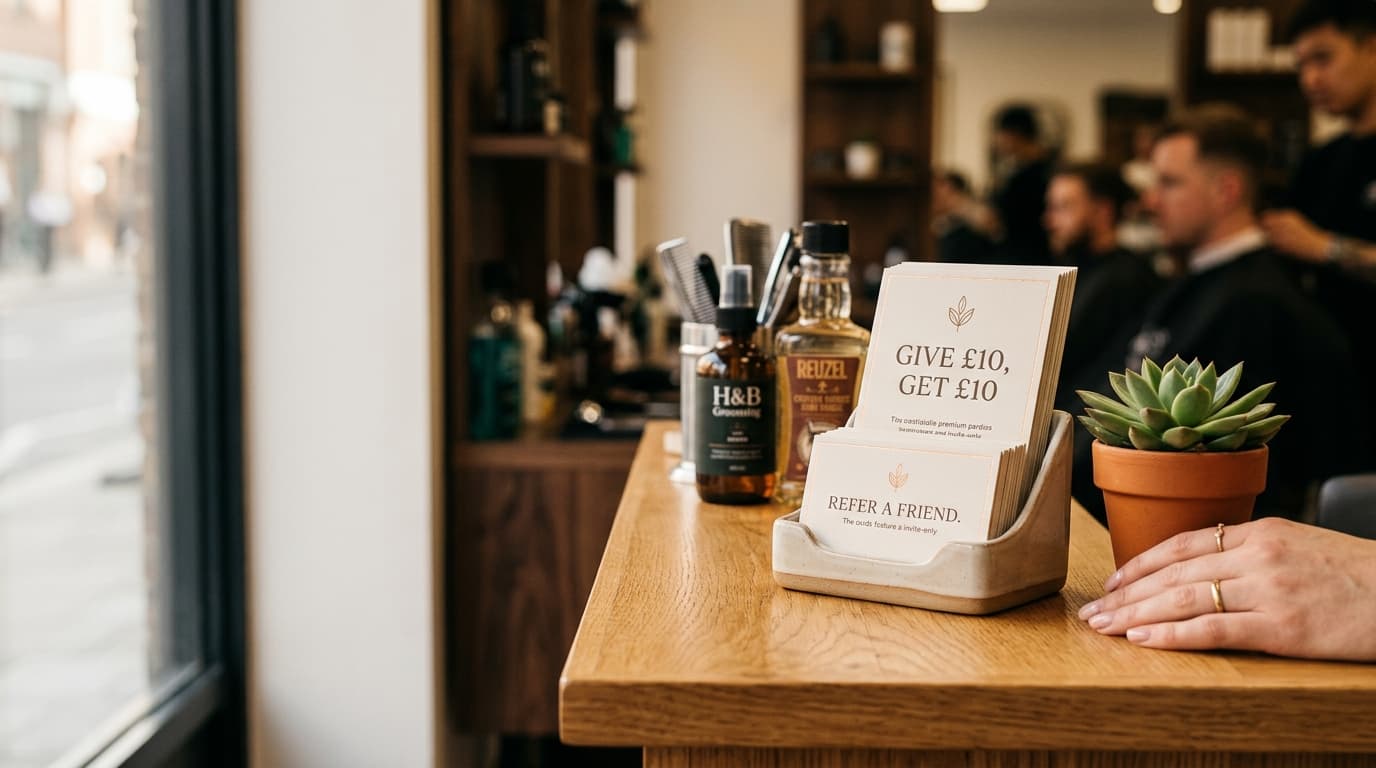
Physical "bring a friend" cards still work well, particularly for clients who are not especially active on their phones. A small, well-designed card with your logo, the offer, and a simple booking link is easy to hand over and easy to pass on. It also doubles as a physical reminder of your brand sitting in someone's wallet.
For clients who prefer digital, a short booking link that pre-fills the referral source is cleaner. The key is that the link is short enough to text without thinking about it.
If you want to understand what your booking page looks like to a new client coming in via referral, your booking page needs to reflect your brand from the first click. A referral is a warm introduction. Do not let a generic-looking booking page undo it.
Tracking Who Is Sending You Business#
This is the part most salons skip, and it is where the real value sits.
When a new client books, tag the referrer on their profile. It takes five seconds. Over time, that data tells you something important: a small number of your clients are responsible for a disproportionate share of your new business.
In most salons, five to ten clients consistently refer. These are your top referrers. They are not just loyal clients. They are active advocates who are filling your books without being paid to do it.
Once you can identify them, you can reward them properly. Not just with the standard referral discount, but with something that signals you have noticed. A handwritten thank-you note. A complimentary treatment upgrade on their next visit. A small gift at Christmas. The specific gesture matters less than the fact that it is personal and unexpected.
Clients who feel genuinely appreciated refer more. It is that simple.
Your Intelligence Dashboard is also worth checking here. Understanding which clients are driving new revenue, not just repeat revenue, changes how you think about retention. A top referrer who churns is a much bigger loss than their own booking revenue suggests.
Building the Habit Into Your Team#
A referral programme only works if the team delivers the ask consistently. That means it cannot live in your head. It needs to be part of the checkout routine, the same way confirming the next appointment is.
Train every team member on the offer and the script. Keep it short: one or two sentences, delivered naturally. The goal is for it to feel like a genuine recommendation, not a sales pitch.
It also helps to track which team members are generating referrals. If one stylist consistently produces referrals and another never does, that is a coaching conversation worth having. Commission Tracking and performance data can help you see patterns across the team without it becoming confrontational.
Review the programme quarterly. Check how many new clients tagged a referrer in the last 90 days. Check whether the rewards are being redeemed. If the numbers are flat, the most common culprit is inconsistent delivery at checkout, not a problem with the offer itself.
When to Run a Referral Push#
Beyond the always-on programme, there are moments when a targeted referral push makes sense.
January is one. Clients are thinking about fresh starts. A "bring a friend this month" campaign sent to your most loyal clients via SMS tends to land well.
After a busy period like Christmas or school holidays is another. Your clients have just had a great experience and are thinking about you. A short message reminding them of the referral offer while that memory is fresh can generate a meaningful spike in new bookings.
For clients who have not visited in a while, win-back campaigns are a separate tool. But for active clients, a referral push is almost always the higher-ROI move.
A Checklist to Get Started#
Here is what a working referral programme looks like in practice:
- Define the offer. Both parties get a reward. Keep it bilateral and simple.
- Set the trigger. Reward redeems when the referred client completes their first appointment.
- Create the mechanism. Physical card, short booking link, or both.
- Train the team. One or two sentences at checkout, every time.
- Tag referrers on every new client record from day one.
- Review quarterly. Check redemption rates and identify your top referrers.
- Reward your top referrers personally. Go beyond the standard discount.
Word of mouth has always been the most powerful marketing channel for salons. The only difference between operators who benefit from it occasionally and those who benefit from it consistently is whether they have built a system around it.
A referral programme that is simple, well-timed, and properly tracked does not require a marketing budget. It requires consistency. And the clients who love your work are already halfway there.